A custom quality model
Question: can a domain-specific scalar function participate in integration and finite-universe normalization without subclassing?
from math import isclose
from fuzzyroutines import (
    Centroid, ComparisonPolicy, ContinuousUniverse, DiscreteUniverse,
    EqualOnDomain, Height, IncludedOnDomain, IntegrationDomain,
    MembershipCallable, MembershipScalar, Normalize, ScalarFuzzySet,
)


def RisingQuality(coordinate: MembershipScalar) -> MembershipScalar:
    """Map a declared score in [0, 100] to its linear membership grade."""

    return coordinate / 100


callback: MembershipCallable = RisingQuality
continuous = ScalarFuzzySet(
    ContinuousUniverse(0, 100, leftClosed=True, rightClosed=True), callback,
)
centroid = Centroid(continuous, IntegrationDomain(0, 100))
assert isclose(centroid, 200 / 3, abs_tol=1e-9)
discrete = ScalarFuzzySet(DiscreteUniverse((0, 25, 50)), RisingQuality)
normalized = Normalize(discrete)
assert Height(discrete) == 0.5 and Height(normalized) == 1
assert tuple(normalized.Membership(coordinate) for coordinate in discrete.universe.points) == (0, 0.5, 1)
policy = ComparisonPolicy("exact")
assert IncludedOnDomain(discrete, normalized, policy)
assert not EqualOnDomain(discrete, normalized, policy)
print(centroid, Height(discrete), Height(normalized))
The callable contract accepts one finite non-boolean real coordinate and
returns a finite grade in \([0,1]\). MembershipScalar expresses the broader
supported scalar input type. Construction checks callability; evaluation
checks the coordinate and returned grade. Keep grades consistent between calls;
the library does not snapshot an arbitrary function's captured mutable state.
The function \(x/100\) has area 50 and first moment \(10000/3\) over \([0,100]\). Its centroid is therefore \(200/3\approx66.666667\), matching the adaptive calculation. The built-in analytical geometry machinery cannot prove exact continuous height or support for an arbitrary callable. Sampling can describe observations, but cannot supply such a proof.
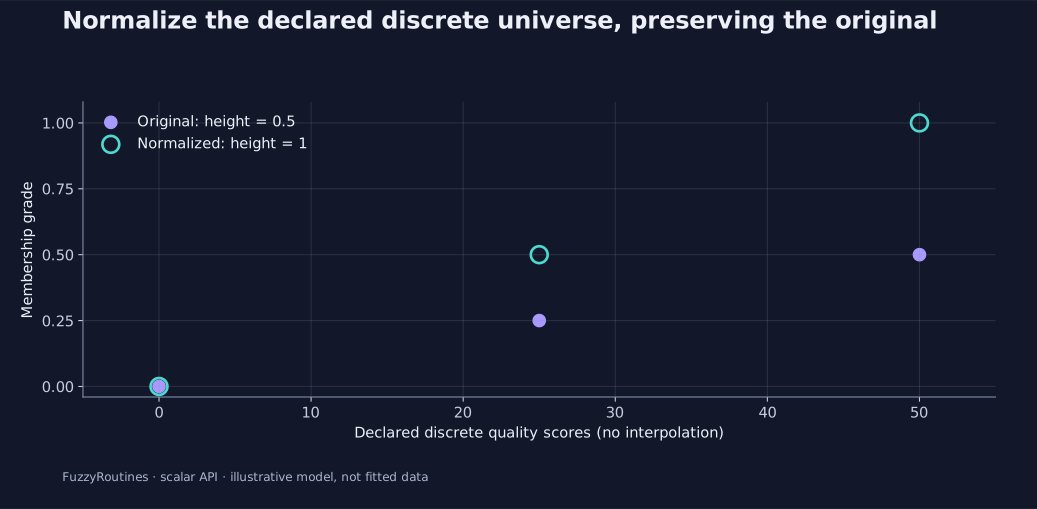
On the discrete universe \(\{0,25,50\}\), exhaustive evaluation proves a
height of 0.5. Normalize divides every grade by that height and returns a new
set; the original is unchanged. The figure deliberately draws only points:
the declared universe contains no intermediate coordinates.
Exact comparison establishes inclusion at all three declared points.
Continuous EqualOnDomain and IncludedOnDomain instead require an explicit
finite ComparisonDomain; they prove agreement only at those observations,
not equality or inclusion everywhere in an interval. A tolerance policy
requires explicit absolute and relative tolerances.
Use in your project: wrap a stable calibration function with a declared universe, retain its units and validation assumptions, and verify independent integrals for representative cases. Normalize only when the semantics of rescaling the largest grade to one fit your application.
python -I examples/guide.py --scenario custom
Continue with the membership gallery or complete API reference.