Choose a membership family
Choose the curve from the meaning of the concept: a tolerance band, a smooth
transition, a central preference, or a monotone tail. The factories return
immutable MembershipFunction objects; they do not fit parameters to data.
All coordinates and parameters must satisfy the documented finite real
contracts. Booleans are not accepted as numbers.
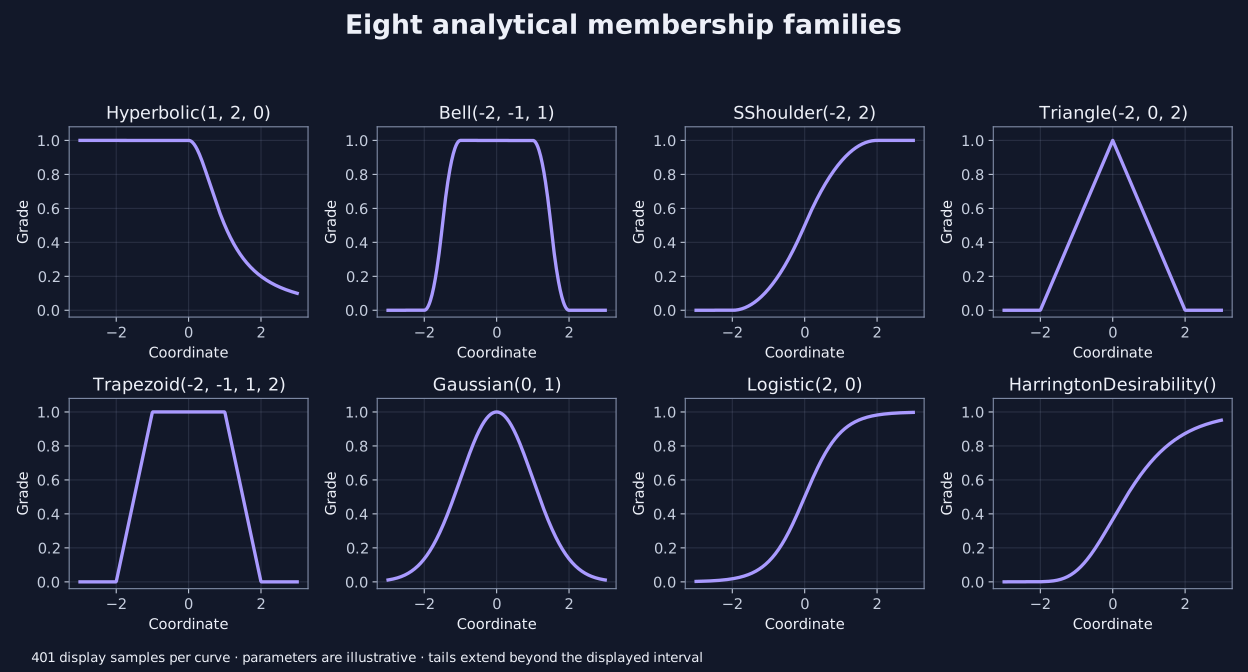
Each curve displays 401 observations over −3 to 3. The displayed interval is not a claim about mathematical support. Gaussian, logistic, desirability, and hyperbolic tails extend beyond it. Numerical underflow at a distant coordinate does not redefine an analytical family's positive support.
Hyperbolic: saturation followed by a decreasing tail
Hyperbolic(scale, exponent, cutoff) is one at and below cutoff and decreases
after it. Positive scale and exponent determine the tail. For an illustrative
penalty, use Hyperbolic(1, 2, 0); at coordinate 1 its grade is 0.5.
Bell: a smooth finite tolerance band
Bell(left, plateauStart, plateauEnd) has quadratic shoulders and a flat
plateau. Its right foot is plateauEnd + plateauStart - left; it is not a
Gaussian. For Bell(-2, -1, 1), the plateau is [−1, 1] and the right foot is 2.
S-shoulder: a smooth transition to saturation
SShoulder(left, right) is zero at and below left, one at and above right,
and quadratic between. Its midpoint grade is 0.5. Use it when an increasing
quantity gradually becomes fully compatible with a concept.
Triangle: a preferred value with linear tolerance
Triangle(left, peak, right) uses the conventional left–peak–right order.
left < peak <= right; a peak at the right endpoint is supported. A symmetric
triangle is convenient for a preferred setting, but asymmetric tolerances are
equally valid. The quality scenario uses Triangle(10, 12, 14).
Trapezoid: a fully acceptable interval
Trapezoid(left, plateauStart, plateauEnd, right) has linear shoulders and a
grade-one interval. plateauStart == plateauEnd is permitted. Use it when a
range of settings is equally acceptable, rather than one preferred point.
Gaussian: smooth preference around a center
Gaussian(center, scale) evaluates the unnormalized membership curve
The scale is positive and the peak is one. This is a membership function, not a probability-density normalization; its area is not constrained to one.
Logistic: a monotone sigmoid
Logistic(slope, midpoint) has grade 0.5 at its midpoint. The slope must be
nonzero: positive slopes increase, negative slopes decrease. No finite
coordinate reaches the mathematical limiting grades zero or one, although
floating-point evaluation can round or underflow to an endpoint.
Harrington desirability: a fixed asymmetric sigmoid
HarringtonDesirability() has no parameters and evaluates
Its input is a dimensionless transformed desirability coordinate. Define that transformation in your model before passing a physical measurement. At zero its grade is \(\exp(-1)\), approximately 0.367879.
Execute every family and inspect an immutable definition
from math import exp, isclose
from fuzzyroutines import (
    Bell, Gaussian, HarringtonDesirability, Hyperbolic, Logistic,
    MembershipFunction, SShoulder, Trapezoid, Triangle,
)

assert Hyperbolic(1, 2, 0)(1) == 0.5
assert Bell(-2, -1, 1)(0) == 1
assert SShoulder(-2, 2)(0) == 0.5
assert Triangle(-2, 0, 2)(0) == 1
assert Trapezoid(-2, -1, 1, 2)(0) == 1
assert Gaussian(0, 1)(0) == 1
assert Logistic(2, 0)(0) == 0.5
assert isclose(HarringtonDesirability()(0), exp(-1))
definition = MembershipFunction("triangle", left=-2, peak=0, right=2)
assert definition.Evaluate(0) == definition(0) == 1
assert definition.family == "triangle" and definition.parameters["peak"] == 0
print(definition.family, dict(definition.parameters))
Factory functions are the easiest entry point. The generic constructor requires
the exact canonical family identifier and parameter names, including
"s_shoulder" and "harrington_desirability". Those string values are data,
not Python declaration names. See the
membership API for all validity constraints.
For a model these families cannot express, use a typed custom evaluator. Continuous exact properties require analytical evidence; an arbitrary callable does not gain such evidence simply by resembling a familiar curve.