Centroids and numerical accuracy
Question: how can we replace a continuous fuzzy profile with one representative coordinate, and verify the number independently?
For a finite integration domain \([a,b]\) with positive membership area,
from math import isclose
from fuzzyroutines import (
    Centroid, ContinuousUniverse, IntegrationDomain,
    ScalarFuzzySet, SNormPolicy, Triangle, Union,
)

universe = ContinuousUniverse(0, 8, leftClosed=True, rightClosed=True)
triangle = ScalarFuzzySet(universe, Triangle(0, 2, 8))
centroid = Centroid(triangle, IntegrationDomain(0, 8))
assert isclose(centroid, (0 + 2 + 8) / 3, abs_tol=1e-12)

combinedUniverse = ContinuousUniverse(0, 10, leftClosed=True, rightClosed=True)
left = ScalarFuzzySet(combinedUniverse, Triangle(0, 1, 3))
right = ScalarFuzzySet(combinedUniverse, Triangle(4, 6, 10))
combined = Union(left, right, SNormPolicy("logic"))
combinedCentroid = Centroid(combined, IntegrationDomain(0, 10))
assert isclose(combinedCentroid, 44 / 9, abs_tol=1e-9, rel_tol=1e-9)
print(centroid, combinedCentroid)
For the first triangle, the geometric centroid is \((0+2+8)/3=10/3\approx3.333333\). This is an independent analytical oracle. The library uses analytical moments for the recognized triangular family.
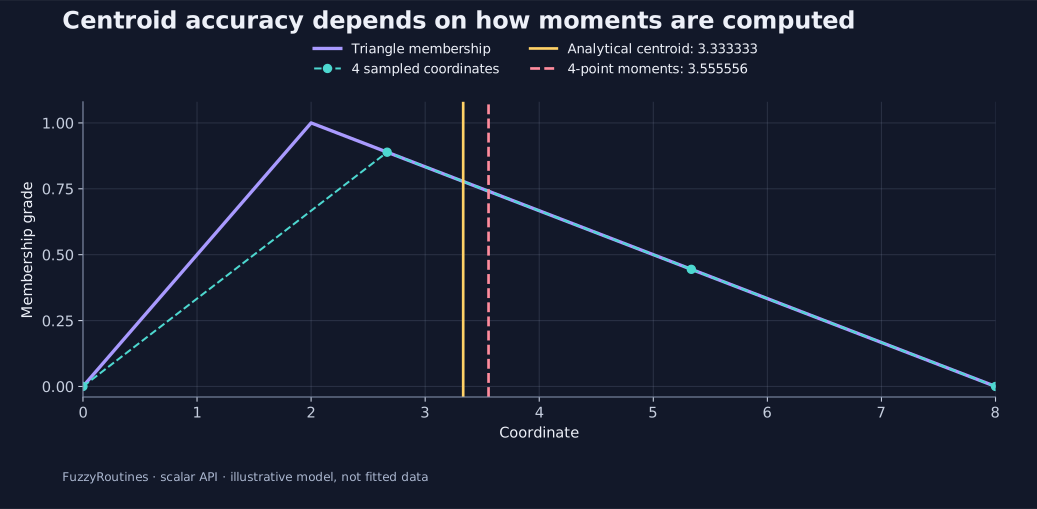
The cyan dashed line joins four user-side samples at \(0,8/3,16/3,8\), whose grades are \(0,8/9,4/9,0\). Applying the trapezoidal rule separately to area and first moment gives
The absolute difference is \(c_4-c=2/9\); the relative difference is
\((c_4-c)/c=1/15\), about 6.67%. The executable scenario implements this
calculation explicitly. Library Centroid does not use that fixed grid.
The picture shows why a coarse sampled representation can change a result.
For the two disjoint triangles, areas are \(3/2\) and \(3\), while their centroids are \(4/3\) and \(20/3\). Because their positive supports are disjoint, maximum union adds their area moments without overlap correction:
The composed callable uses adaptive quadrature. Its observed result agrees with this oracle within the asserted \(10^{-9}\) tolerance.
Engineering checks: an integration domain must lie within the continuous
universe. Zero area raises UndefinedResultError. Exhausting the adaptive
depth raises CentroidConvergenceError, rather than returning a silent fallback.
The policy's tolerances govern moment integration; they are not a proven
absolute bound on centroid-coordinate error. Generic functions must be
sufficiently regular: narrow features missed by quadrature cannot be ruled out
by finite evaluation alone. Choose domain and model accordingly.
Use in your project: record units, finite integration limits, policy, and an independent reference when a representative coordinate influences a decision. Truncating a curve changes the centroid being requested.
python -I examples/guide.py --scenario centroid
Continue with scale auditing.