Maintenance warning zones
Question: how strongly is a temperature in the warning zone while outside the critical zone? Both models describe the same 40–120 °C universe, so they can be composed as fuzzy sets.
from fuzzyroutines import (
    Complement, ContinuousUniverse, Difference, Intersection, NegationPolicy,
    ScalarFuzzySet, SNormPolicy, SShoulder, TNormPolicy, Union,
)

universe = ContinuousUniverse(40, 120, leftClosed=True, rightClosed=True)
warning = ScalarFuzzySet(universe, SShoulder(60, 100))
critical = ScalarFuzzySet(universe, SShoulder(90, 110))
negation = NegationPolicy("standard")
conjunction = TNormPolicy("logic")
warningWithoutCritical = Difference(warning, critical, conjunction, negation)
noncritical = Complement(critical, negation)
both = Intersection(warning, critical, conjunction)
either = Union(warning, critical, SNormPolicy("logic"))
assert warning.Membership(100) == 1
assert critical.Membership(100) == 0.5
assert warningWithoutCritical.Membership(100) == 0.5
assert noncritical.Membership(100) == both.Membership(100) == 0.5
assert either.Membership(100) == 1
print(warningWithoutCritical.Membership(100))
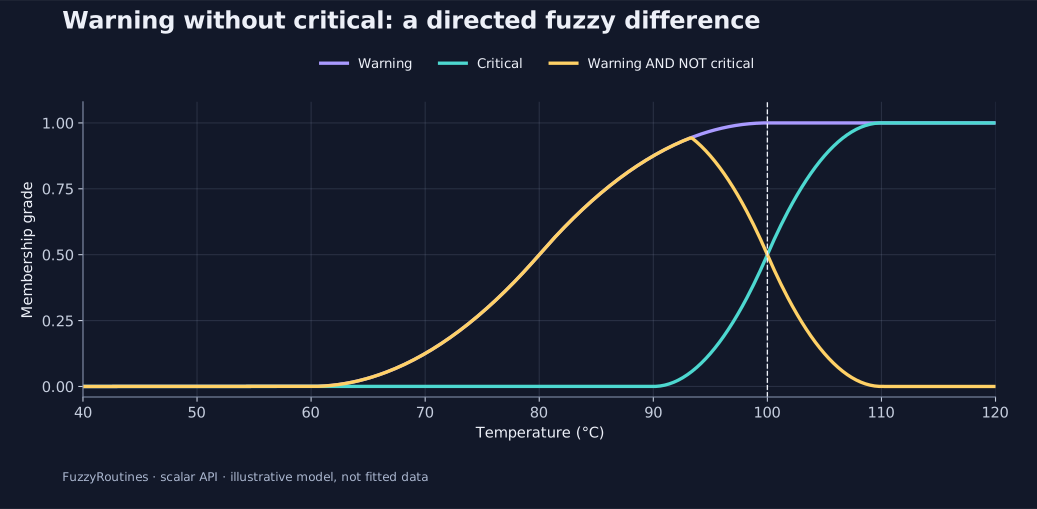
With standard negation and minimum conjunction,
At 100 °C this is \(\min(1,1-0.5)=0.5\). The difference is directed: reversing warning and critical changes its meaning. It is not ordinary subtraction, and it does not implement arithmetic on fuzzy numbers. The composition declines to zero when the critical grade reaches one.
Use in your project: retain the warning and critical grades as well as the composed result so a dashboard can explain its decision. These demonstration thresholds need application-specific validation before operational use.
python -I examples/guide.py --scenario alarm
Continue with quality alpha cuts.