Combine two sensor criteria
Question: how strongly do an 80 °C temperature and 10 mm/s vibration satisfy two illustrative warning criteria? Convert each physical measurement to its own dimensionless grade before combining them. The model does not infer a failure probability.
from fuzzyroutines import SNormPolicy, SShoulder, TNormPolicy, Triangle

temperatureGrade = SShoulder(60, 100)(80)
vibrationGrade = Triangle(0, 8, 16)(10)
minimumAnd = TNormPolicy("logic").Evaluate(temperatureGrade, vibrationGrade)
productAnd = TNormPolicy("algebraic").Evaluate(temperatureGrade, vibrationGrade)
maximumOr = SNormPolicy("logic").Evaluate(temperatureGrade, vibrationGrade)
algebraicOr = SNormPolicy("algebraic").Evaluate(temperatureGrade, vibrationGrade)
assert (temperatureGrade, vibrationGrade) == (0.5, 0.75)
assert (minimumAnd, productAnd, maximumOr, algebraicOr) == (0.5, 0.375, 0.75, 0.875)
print(minimumAnd, productAnd, maximumOr, algebraicOr)
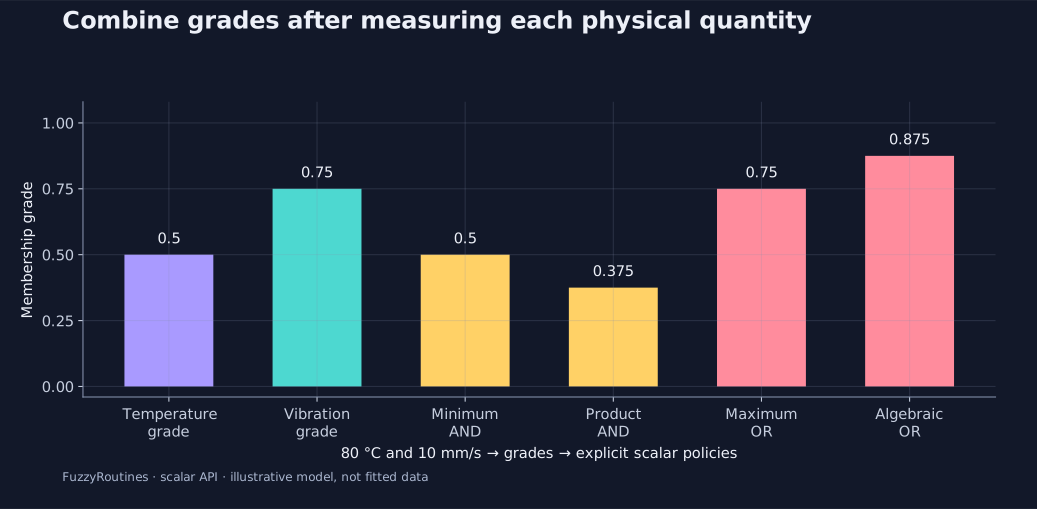
Minimum conjunction retains the weaker grade: \(\min(0.5,0.75)=0.5\). Product conjunction gives \(0.5\times0.75=0.375\). Maximum disjunction gives 0.75; algebraic disjunction gives
These are different fuzzy operator choices, not competing performance modes. Using a product T-norm does not establish probabilistic independence.
Engineering check: the inputs have different units and universes, so use
scalar policy Evaluate here. Set-level Intersection and Union require
sets on the same universe. A full temperature–vibration rule base would need
an explicitly defined multivariate inference layer, which this example does
not implement.
Use in your project: record the chosen policy alongside the criterion thresholds. The four values show why changing a policy can change a downstream decision even when the measurements remain identical.
python -I examples/guide.py --scenario sensors
Continue with maintenance warning zones.