Choose how grades combine
Question: should two partially satisfied criteria require the weaker grade, or should their partial satisfaction compound? The choice is a model policy. First measure each physical quantity with its own membership function; combine the resulting dimensionless grades. For set composition, both sets must share the same universe.
For two grades \(a,b\in[0,1]\), the illustrated policies are
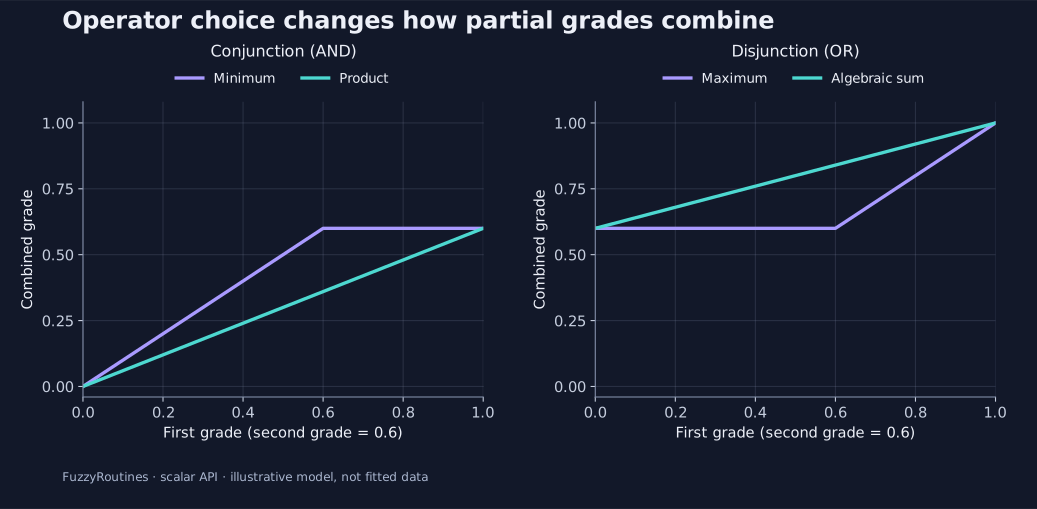
The horizontal coordinate varies the first grade from zero to one; the second is fixed at 0.6. On the left, minimum saturates at 0.6 while product scales the first grade by 0.6. On the right, maximum stays at least 0.6 while algebraic disjunction rises continuously to one. These are explicit fuzzy policies, not an assumption that the measurements are statistically independent.
from math import isclose
from fuzzyroutines import NegationPolicy, SNormPolicy, TNormPolicy

first, second = 0.4, 0.6
assert TNormPolicy("logic").Evaluate(first, second) == 0.4
assert isclose(TNormPolicy("algebraic").Evaluate(first, second), 0.24)
assert SNormPolicy("logic").Evaluate(first, second) == 0.6
assert isclose(SNormPolicy("algebraic").Evaluate(first, second), 0.76)
assert NegationPolicy("standard").Evaluate(first) == 0.6
print(0.4, 0.24, 0.6, 0.76)
Standard negation is \(N(a)=1-a\). A directed difference uses conjunction with the negated second grade: for minimum conjunction, \(\mu_{A\setminus B}(x)=\min(\mu_A(x),1-\mu_B(x))\). It is not ordinary subtraction. The alarm scenario shows the resulting curve. Boundary and drastic alternatives, plus parametric and parabolic negations, have executable examples in the API recipes.
Use in your project: retain the selected policy with your model and compare intermediate grades before changing it. A product can lower an AND result substantially; that does not mean the implementation is slower or less accurate. The choice expresses how partial compatibility should combine.